
What Determines Beacon Battery Life
Battery life is the single most persistent operational concern in any beacon deployment. Unlike fixed infrastructure such as Wi-Fi access points, beacons run on disposable or rechargeable cells and will eventually stop broadcasting. The question is not whether a beacon will need attention, but when, and whether you will know about it before it goes silent.
Manufacturer datasheets typically quote battery life under controlled conditions: a specific advertising interval, a fixed transmit power, and a stable room temperature. These figures are useful for comparing one hardware model against another, but they do not represent a reliable prediction for your site. A beacon rated by its manufacturer for a certain number of months on a CR2477 coin cell under test conditions will typically deliver less in a cold warehouse and potentially more in a stable museum environment. The variables that matter most are advertising interval and transmit power, both of which are covered in detail in the next article in this series, but ambient temperature, battery chemistry, and manufacturing tolerance also play a significant role.
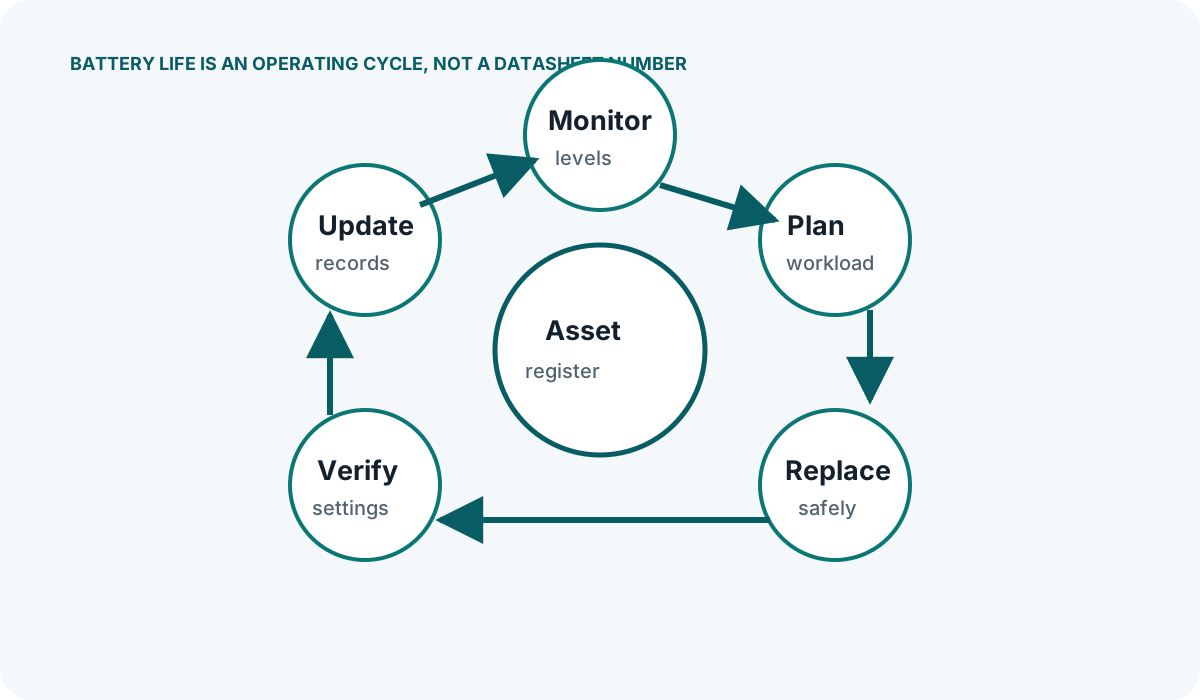
Maintenance, in this context, means more than swapping batteries. It encompasses knowing which beacon is installed where, tracking when each unit was deployed, estimating when replacement will be needed, and having a practical process for carrying out that replacement without disrupting operations. For any deployment beyond a handful of units, this requires a record-keeping system, whether a spreadsheet or a dedicated asset register.
Planning Maintenance in Real Venues
The operational demands on beacon batteries vary considerably depending on the environment and use case.
In retail settings, beacons are often ceiling-mounted above specific product zones or tucked onto shelving. Ceiling-mounted units in shops with automatic doors may experience regular temperature fluctuations, particularly in winter, which can reduce effective battery life. Shelving-mounted beacons are easier to access for replacement but may be more vulnerable to physical disturbance.
Museums typically offer stable, climate-controlled environments, which is favourable for battery longevity. However, museums also tend to use dense beacon installations for indoor navigation and exhibit-triggered content, meaning a large number of batteries to track. Access can be an issue if beacons are mounted high above display cases or integrated into fixed structures.
Event deployments present a different pattern. Beacons may be configured with aggressive advertising intervals to support real-time indoor navigation over a short conference or exhibition. Under those conditions, a coin cell that might last years in a museum could be depleted in a matter of days. For recurring events, some organisers treat batteries as a per-event consumable and replace them as standard preparation, much like replacing lanyard badges.
Warehouses and industrial spaces combine several challenges: large floor areas requiring many beacons, difficult access at height, and temperature extremes. A loading bay with roller-shutter doors open in January will subject nearby beacons to conditions far removed from the datasheet norm.
Temperature effects on battery capacity
Temperature deserves particular attention. Coin cell lithium batteries deliver less capacity at low temperatures. As temperatures approach freezing, capacity drops noticeably compared with performance at a comfortable room temperature. Conversely, sustained high temperatures accelerate self-discharge and can reduce overall cell life. If your site includes areas that are noticeably colder or warmer than the rest of the building, expect variation in battery life between zones and plan replacement schedules accordingly.
Physical access for replacement
Physical access is easily overlooked during planning. A beacon mounted high on a warehouse truss may require a mobile elevated work platform to reach. If the replacement interval is frequent, that is a recurring cost and safety consideration that should factor into the original deployment decision. In some cases, choosing a beacon model with a larger battery or an external power option may be more economical than repeated high-access maintenance visits.
Failure Modes and Maintenance Checks
The most common mistake is treating the manufacturer's battery life figure as a guaranteed service interval. It is not. It is a comparative benchmark. Without measuring actual performance in your environment, you are estimating.
A related error is assuming all beacons in a deployment will fail at roughly the same time. Even identical units from the same batch will show variation in battery life due to manufacturing tolerance and minor differences in local conditions. If you plan to replace all batteries on a single date, some units will have been running on depleted cells for weeks beforehand, potentially broadcasting at reduced power or not at all.
Failing to track beacons in an asset register is another frequent problem. When a beacon goes silent, staff need to know which physical unit corresponds to which record, where it is located, and when its battery was last replaced. Without this information, troubleshooting becomes a process of elimination that wastes operational time.
Some organisations replace batteries on a fixed calendar schedule regardless of actual condition. While simple to administer, this approach either wastes battery life by replacing cells too early or risks silent beacons by replacing too late. A more effective approach is to combine scheduled checks with observed performance data, such as declining signal strength reported by receivers or periodic manual surveys.
Key checks during maintenance
- Inspecting the beacon housing for cracks, moisture ingress, or discolouration that might indicate heat exposure or physical damage.
- Confirming that the beacon is broadcasting at the expected power level after battery replacement, rather than assuming a fresh cell means full performance.
- Verifying that the beacon's identifiers have not been accidentally reset during the battery change, which would break its association with your system.
- Checking that the mounting is secure and has not shifted since the previous inspection.
- Recording the replacement date, battery batch or brand, and any observed anomalies in your asset register.
A fundamental limitation: most beacons do not report their own battery level
A practical limitation to understand is that most standard BLE beacons do not report their own battery voltage to a central system. They simply broadcast their identifiers at whatever power the cell can support. As the battery drains, transmit power may drop gradually, reducing the effective range before the beacon stops entirely. Some enterprise-grade models include voltage telemetry in their broadcast packet, but this is not universal. Without telemetry, you rely on indirect signals such as receivers reporting weaker RSSI values from a known beacon, or on scheduled physical inspections.
When questioning a beacon supplier or integrator about battery life and maintenance, useful points to raise include: what battery chemistry the unit uses and whether alternative cell sizes are supported; whether the firmware reports voltage or estimated remaining capacity; what the observed battery life has been in deployments with environmental conditions similar to yours; and what recommendations they offer for replacement intervals in environments with temperature variation.
Advertising interval belongs in a measured power budget
A shorter advertising interval usually produces more transmissions and can increase energy use, but battery life also depends on transmit power, chipset, sensors, connection activity, temperature, battery chemistry and firmware. Treat supplier estimates as planning inputs only. Record the configured interval and power for each fleet, sample current draw where the deployment matters, and compare observed replacement dates with the estimate.
Do not optimise battery life in isolation. An interval that saves energy but delays detection or reduces the number of useful samples may fail the service. Select settings through a venue test that measures both detection behaviour and expected maintenance effort.

